

Many flexible circuit board applications require
designs to be exposed to and or operate continuously at
elevated temperatures well beyond that of standard room
temperature. These requirements are above and beyond the
requirements of component or connector assembly.
Materials for flexible circuit boards are rated to
withstand a RoHS solder reflow temp profile. These
applications vary from short-term elevated temperature
exposures, such as autoclaving of medical devices, to
designs that operate continuously at extreme
temperatures, such as down hole drilling electronics and
applications that can see greater than 200°C for
extended lengths of times.
To address these requirements, the industry has a
variety of flex materials that have different maximum
operating temperature capabilities. The end result is a
dependable flexible PCB design that will be built on the
materials specified throughout the construction.
Flexible circuit boards are constructed of 3 standard
materials: copper for the printed circuit board
patterns, flex core(s) to which the copper circuitry is
attached, and coverlays, which encapsulate the external
circuit layers serving the same function as soldermask
on a rigid-flex printed circuit board.
Some flex circuit designs may also require stiffeners,
to Support component/connector areas, PSAs
(double-sided, pressure-sensitive adhesive) to attach
the flex within the enclosure or shielding films for
EMI-sensitive applications. For each of the above
materials, there are multiple options that have
different maximum operating temperature capabilities.
For a typical -40°C to 85°C requirement, all standard
flex materials are capable, and no additional material
or construction-related considerations are necessary. At
higher temperatures, the materials and constructions
will need to change.
Flex cores are available in two different types of
constructions. They differ in how the copper circuit
layer(s) are attached to the central polyimide core. The
original flex core materials use a layer of adhesive to
bond the copper to the polyimide core. The later
material type has the Polyimide cast directly onto the
copper thus eliminating all adhesive layers. This type
of flex core is referred to as an “Adhesiveless Flex
Core”. The standard practice, once the temp requirements
rise above the common 85°C requirement, is to use
adhesives flex cores. We will discuss the specifics as
to why further along in this blog. The polyimide layer
as a maximum temp in the 400°C range and is not of
concern.
Coverlays consist of an external polyimide layer and a
layer of flexible adhesive. They are laminated, under
heat and pressure, onto the surface of the circuits with
the adhesive serving both to attach the coverlay and to
encapsulate the circuitry. There are 3 different types
of adhesive available all with different temp rates
which we will discuss in detail further along in this
blog.
Stiffeners are available in polyimide, FR4, stainless
steel, and aluminum. Stiffeners are attached using
either the same adhesives as used with coverlays or in
some cases a PSA. The only temperature-related
considerations are if FR4 is used, and the type of
adhesive used for attachment.
PSAs are available in an extremely wide range from
multiple suppliers. 3M and TESA are the most commonly
used material brands. The PSA selected will need review
to ensure it meets both the temp and adhesion
requirements of the design specification.
Flex circuits can be EMI shielded using either
additional copper layers, dedicated shielding films, or
silver ink layers. The use of silver ink has diminished
significantly over the last 10 years and is not commonly
recommended anymore.
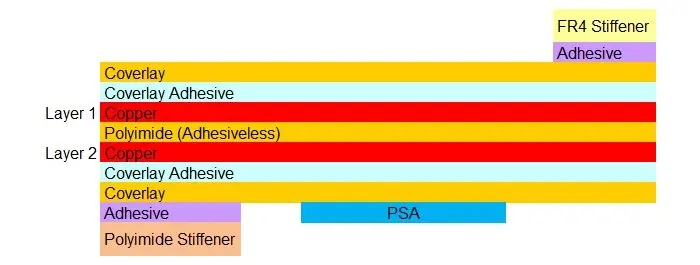
Example of a 2-layer flexible printed circuit board construction.
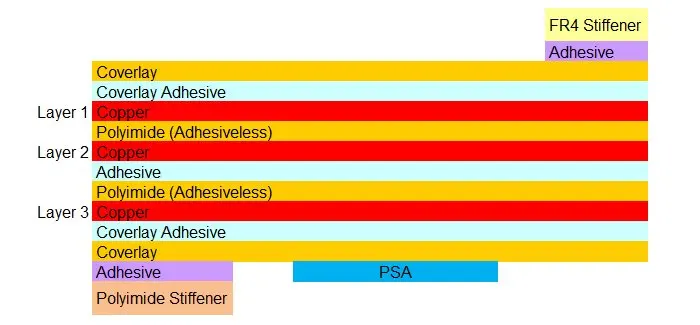
Example of a 3-layer flexible printed circuit board construction.
Flexible Adhesives
Flexible adhesives are used in three specific areas:
coverlay attachment, layer-to-layer lamination in
3-layer or greater designs, and stiffener attachment.
There are three types of adhesives that can be used:
acrylic-based, modified flexible epoxy, and polyimide
coating. Each of these has different continuous
operation temperature ratings. Acrylic adhesives have
the lowest temp rating and are used for standard
applications without any significant elevated
temperature requirements. Epoxy-based adhesives are
rated in the 130 – 140°C range and polyimide base
adhesives are rated at 220°C+. Epoxy adhesives, as an
example, are suitable for medical applications that
require autoclaving.
Polyimide-based adhesives, as an example, are required
for down-hole drilling applications that have a 200°C
continuous temp specification. Polyimide adhesives
require very high temperatures for lamination. While
acrylic and epoxy adhesives are laminated in the 180 –
200°C range, polyimide adhesives require 307- 316°C. Not
all flex circuit manufacturers may have high-temp
lamination capabilities. Polyimide-based adhesives are
also significantly more expensive than acrylic or epoxy
adhesives which are cost comparable.
Flexible Circuit Board PSAs & Stiffeners
This an extremely wide variety of PSAs are available.
Most have fairly high operating temperatures, but the
adhesion strength will vary depending upon the
temperature. For a flex application adhesion strength is
usually not a significant requirement as the PSA on the
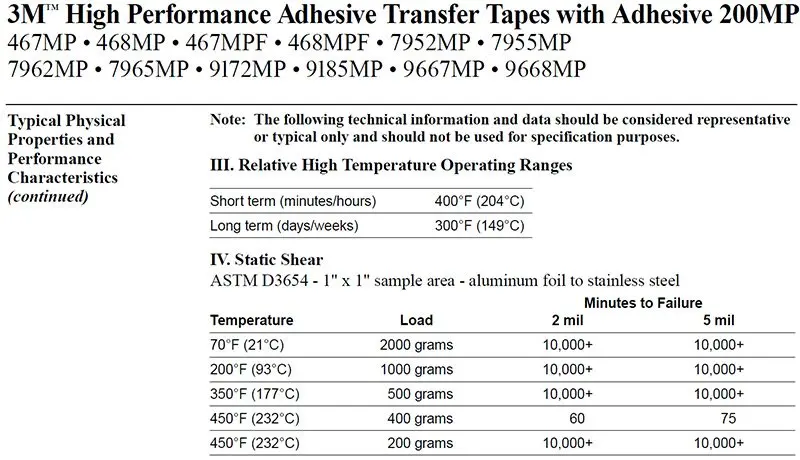
flex is not subjected to any high forces. The following
is the specifications for the most commonly used 3M
467MP PSA as an example:
For stiffener applications, beyond the previously discussed adhesive requirements, the only potential temperature issue may occur with FR4 stiffeners. Stainless steel, aluminum and Polyimide stiffeners have temperature ratings way beyond what will be required. We recommend following the same FR4 requirements for a comparable 2-layer rigid-flex PCB operating at the same temperature for the FR4 stiffeners.
Flex Circuit EMI Shielding
EMI shielding can be achieved using either EMI shielding
films or additional solid or cross-hatched, copper
layers. We will not cover silver ink shielding as this
method is rarely used in modern designs. Copper layer
shields provide the highest possible operating temps and
will be temp-rated based upon the adhesive used as this
will require a flex construction of 3-layer or more.
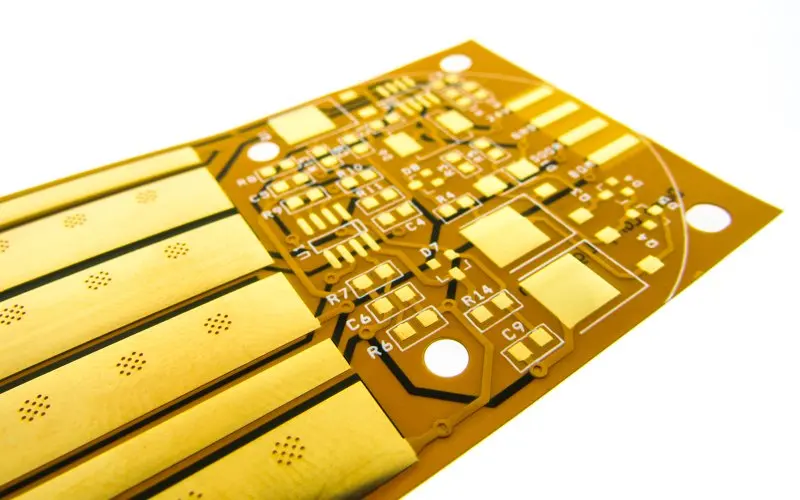
Flex circuit with solid layer of copper EMI shielding.
The negative impacts of copper layer shielding are
the significant increase in flex thickness, and the
resulting reduction in flexibility and bend capability,
and the increase in part cost. EMI shielding films are
the preferred Products for flexibility/bend capability
and cost-effectiveness but are limited to 125°C max.
continuous operating temp.
EMI shielding films are laminated to the surface of the
part in a similar method as overlays. The adhesive used
in the shielding film is used to both attach the film
and electrically connect it to the ground net within the
flex circuit. Exceeding the operating temperature will
increase the electrical contact resistance and
potentially compromise the effectiveness of the shield.
For temperatures greater than 125°C the only viable
option is additional copper shielding layers.